


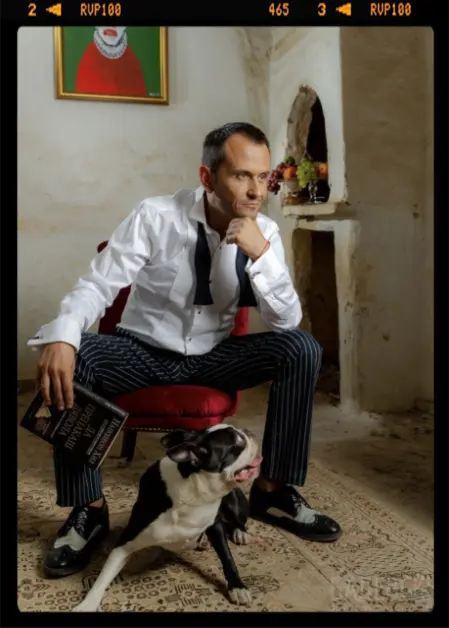
DIMITAR STEFANOV
Artistic & Experiential Director | Curator of Luxury Experiences
About the author
Dimitar Stefanov is a Creative & Experiential Director with over 20 years of experience in luxury events, hospitality and guest experiences. With a background in acting and theatre directing, he approaches luxury through the relationship between people, places and experiences. His concept of Emotional Architecture of Luxury explores how creative direction, professional excellence and human connection can transform exceptional moments into meaningful experiences.
THE EMOTIONAL ARCHITECTURE OF LUXURY
1.Part I — The Art of Not Being the Centre
There comes a moment when a person realises that the world does not revolve around them. This does not make them any less significant. On the contrary, it gives them an opportunity to better understand the people with whom they share that world.
Sometimes, that is precisely when the possibility arises of becoming the centre of someone else’s experience. Not because you demanded attention, but because you created something that matters to another person.
In the world of luxury, this principle has a very practical dimension.
A brand may possess a remarkable history, an impeccable product and international recognition. An event may impress with its architecture, lighting, music and meticulous organisation. But none of these qualities, on its own, guarantees that the person on the receiving end will feel something special.
This does not mean that the product, craftsmanship or high standards are secondary. Quite the opposite: they are the foundation without which the promise of luxury can easily become mere decoration.
But there is a difference between demonstrating how exceptional something is and creating the conditions for someone to discover its value for themselves.
That difference requires more than taste and professional skill. It requires character — the ability to maintain your own creative position without making yourself the protagonist of someone else’s experience.
For me, this is where the emotional architecture of luxury begins.
Not as an attempt to prescribe what people should feel, but as the deliberate creation of space, rhythm and relationships in which a genuine experience can emerge.
And this is not merely philosophy.
It begins with concrete decisions — how we welcome a guest, how we present a product, how we organise an encounter and what we leave behind after it.
2.Part II — From Philosophy to Reality
Every meaningful experience has its own structure. And just as a building cannot stand without foundations, luxury cannot rely on emotion alone.
For an object, the foundation is its quality — materials, design, craftsmanship and functionality. For an event, it is the concept, the people, the organisation and the ability to deliver on what was promised. The experience is built upon this foundation.
Take, for example, one of Hermès’ iconic bags — the Birkin or the Kelly.
Its value does not begin the moment someone holds it in their hands. Behind it lie design, materials, artisanal skill, tradition and a recognisable identity. That is the foundation.
But to the person who owns it, the bag may mean something else as well — personal achievement, a memory, the pleasure of beauty, or simply the satisfaction of owning an object they love.
None of these feelings is obligatory. And none can be prescribed in advance by the brand.
The same principle applies to creating an event.
Imagine a new collection being presented to eighty guests. The foundation includes a clear concept, an appropriate venue, technical preparation, a trained team and flawless organisation.
Then comes the architecture of the experience.
The invitation creates anticipation. The welcome establishes the first human connection. Space, light and rhythm guide attention. The presentation reveals the qualities of the product. A personal conversation allows the guest to discover their own connection to it.
Sometimes, the most important directorial decision is what not to reveal immediately.
The point is not simply to create surprise. When we show everything at once and explain every meaning in advance, we risk turning the guest into a consumer of impressions.
When we leave room for curiosity, observation and personal discovery, that person is no longer merely a spectator. They participate in shaping their own experience.
And the finale is not simply the moment when the event ends. It is the way in which relationships can continue.
All of this requires concrete decisions, budgets, responsibilities and coordination. Emotional architecture does not replace professional organisation. It gives it a human direction.
Nor should the result be judged solely by applause or beautiful photographs. The quality of interactions, interest in the product, subsequent meetings and the relationships that develop also matter.
Because a well-created experience is not necessarily the loudest or the most expensive.
It is one in which the product retains its value, the brand its identity, and the person the freedom to discover their own meaning.
3.Part III — Three Questions. No Conclusion.
1. If you removed the name, the price and the status from something you consider luxurious, what would still make it special to you?
2. If you could ask yourself just one practical question after reading this article, what would it be?
3. Yet to be discovered.
